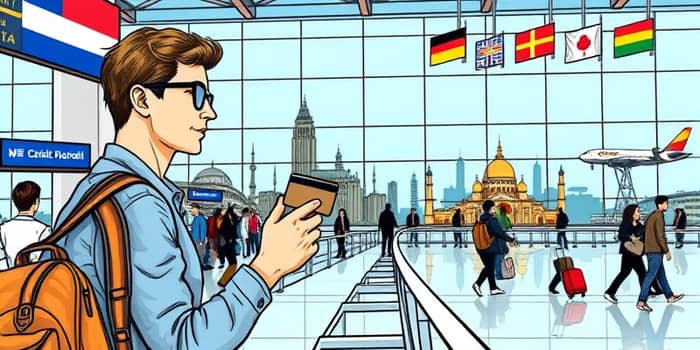
Embarking on a journey across borders transforms us into true global citizens. Every swipe, tap, or insert of a credit card can unlock new experiences, from savoring street food in Tokyo to browsing artisan markets in Barcelona. Yet with endless possibilities come responsibilities: understanding fees, navigating security risks, and choosing the right network for seamless international transactions.
In this comprehensive guide, we dive into acceptance rates, ownership statistics, economic trends, cost structures, and security insights. Our goal is to empower you with practical tips for confident spending and inspire every traveler to take on the world with clarity and excitement.
When you arrive in a new country, your choice of credit card network can determine how smoothly you pay. Visa proudly dominates in 123 countries worldwide, including France, Germany, Indonesia, Japan, and Spain. Mastercard leads in 22 nations such as Australia, Brazil, and Canada. Meanwhile, American Express commands top acceptance in 23 markets including the United Kingdom and the United States, where it boasts 99% merchant acceptance alongside Discover.
Regionally, Visa and Mastercard maintain the most consistent reach, while AMEX often offers higher success rates per transaction. Debit cards may vary dramatically in acceptance, so carrying a major credit card network logo on your plastic provides an added layer of reliability abroad.
Ownership levels tell a story about consumer behavior and financial infrastructure. Globally, only about 22.26% of people hold credit cards, but this average masks vast disparities:
In the United States alone, over 800 million cards circulate, with each American holding an average of 3.9 cards. Among under-25s, 64% have at least one card, up from 56% in 2013.
The growth of credit card usage mirrors broader economic trends. U.S. credit card balances projected to hit $1.18 trillion by the end of 2026 reflect a 2.3% year-over-year increase. Average individual debt stands at $6,730, up 3.5% in 2024.
Spending soared to $3.2 trillion in 2022, with Q4 recording $846 billion in charges. General-purpose cards powered over 100% growth from 2015 to 2022. Today, credit cards account for 31% of all U.S. transactions, with 69% of purchases made online and 32% of those via mobile devices. Globally, the market’s expected to reach $117.77 billion by 2030, at a 2.5% CAGR.
Bit by bit, interchange fees can sting your wallet abroad. Here’s how consumer credit interchange fees compare internationally:
U.S. cardholders face some of the world’s highest rates. To minimize charges, avoid dynamic currency conversion fees and choose credit cards with low or waived foreign transaction fees.
Travelers confront growing threats: global fraud losses may hit $43 billion by 2026, with account takeover fraud responsible for 33% of incidents. Yet technology fights back. Biometric authentication is used by 84% of cardholders, and contactless payments now represent half of in-person transactions.
The payments landscape is rapidly evolving. Virtual cards for businesses are projected to reach $500 billion by 2025, while mobile wallets will serve 5 billion users. Fintech platforms see 71% year-over-year origination growth. Inflation pressures have driven 18% more middle-income Americans to rely on cards for everyday expenses.
To stay ahead, embrace mobile wallets and digital cards, explore virtual payment options for subscriptions, and update apps that support contactless and biometrics. This ensures you can spend confidently in any currency, on any device.
Becoming a global citizen means blending data-driven planning with an adventurous spirit. Knowing where and how your credit cards work, and what costs or risks you’ll face, gives you the freedom to focus on discovery rather than logistics.
Activate travel alerts on your account, carry a backup payment method, and always prioritize security over convenience. With these strategies, every payment becomes part of your story—fueling memories from rooftop bars in Buenos Aires to hidden temples in Bali.
Step onto the tarmac, swipe your card, and embrace the world’s tapestry of cultures, cuisines, and possibilities. With knowledge as your compass and a credit card in your hand, your journey knows no borders.
References