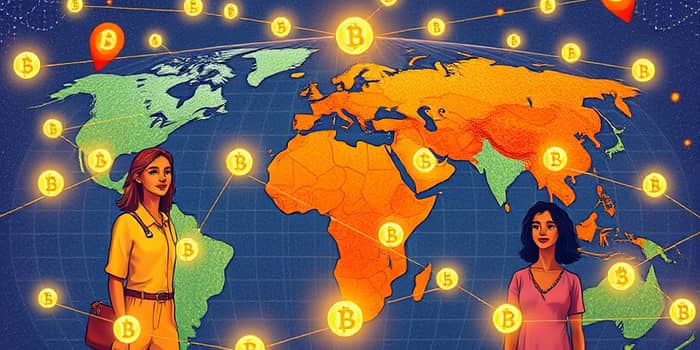
In an era where nearly 4 in 5 adults worldwide hold a bank account, the conversation around financial inclusion has evolved beyond mere access. Today, it centers on economic resilience, health, and true empowerment. At the heart of this shift are digital assets—cryptocurrencies, stablecoins, tokenized real-world assets, and programmable money—that promise to reshape how people save, invest, and transact across borders.
Over the past decade, mobile adoption and infrastructure development have laid a strong foundation. Financial inclusion has entered a maturity phase, with traditional development models blending into commercial viability. Donor-funded programs are giving way to hybrid approaches that leverage technology and investment-led sustainability.
This progression underscores an important shift: providing an account is no longer sufficient. The emphasis now is on outcomes—resilience against economic shocks, access to diversified investments, and the ability to participate meaningfully in the global economy. Digital assets intersect at each of these goals, offering unprecedented tools for change.
In regions of South Asia and Sub-Saharan Africa, the proliferation of affordable smartphones has become a catalyst for progress. Mobile ownership, once a luxury, is now a prerequisite for financial services. This digital bridge allows fintech innovators to tailor solutions that reflect local contexts, delivering savings, credit, and insurance products through intuitive interfaces.
By enabling low-cost, borderless access to finance, digital assets reduce barriers for unbanked and underbanked populations. Fractional ownership unlocks high-value investments—real estate, art, even homes—into affordable shares, sometimes as little as $1,000. This democratization allows individuals to build wealth previously reserved for the few.
Key projections for 2026 illustrate this momentum:
These numbers reflect not only institutional appetite but also growing retail interest. Stablecoins, pegged to fiat, now serve as digital cash equivalents, powering remittances and real-time cross-border payments.
Consider a small business owner in Southeast Asia sending earnings home. Traditional remittance corridors can charge up to 8% in fees and take days to settle. Using stablecoins on a blockchain network, this entrepreneur can transfer funds in minutes with fees under 1%, retaining more earnings and reinvesting in growth.
The true power of these instruments lies in their ability to foster resilience. Programmable money enables automated savings plans, micro-insurance products, and transparent disbursement of aid funds. In regions where banking infrastructure is limited, stablecoins and tokenized deposits offer round-the-clock access to digital cash.
Fractional ownership models encourage diversified portfolios, reducing exposure to local economic volatility. For someone in a remote village, owning a slice of global real estate or government bond becomes possible with minimal capital. This inclusion nurtures long-term economic growth by embedding individuals into global financial systems.
Regulatory clarity is critical to sustaining this revolution. In the United States, legislation like the GENIUS Act and CLARITY Act aims to establish robust frameworks for stablecoins and broader digital assets. Harmonization efforts between SEC and CFTC seek to define clear taxonomies and reduce ambiguity around tokenized securities.
Globally, policymakers pursue interoperability standards and cross-border cooperation. Yet challenges remain: AML scrutiny can stall partnerships, and public skepticism demands transparent governance. Successful digital inclusion hinges on collaboration between regulators, traditional financial institutions, and emerging blockchain networks.
To harness the potential of digital assets for inclusive finance, stakeholders should consider the following:
Stakeholders must also prioritize education and risk awareness. High volatility and fraud threats in digital asset markets necessitate comprehensive consumer protection measures and literacy campaigns. Empowering users with knowledge ensures that inclusion efforts do not inadvertently expose individuals to financial harm.
As we look ahead, the intersection of AI, blockchain, and mobile technology presents unparalleled opportunities. Distributed architectures will embed financial services seamlessly across platforms, while data insights personalize offerings for individual needs. Though funding contractions pose risks to talent retention, they also encourage lean, sustainable innovation.
Now is the moment for communities, innovators, and leaders to join hands. By bridging technology with purpose, we can ensure that no individual is left behind. The fusion of digital assets and inclusive design offers a blueprint for a fairer, more connected world—one where opportunity flows freely across every frontier.
Ultimately, democratizing access through digital assets is not just a technological endeavor—it is a social imperative. By empowering individuals with programmable, borderless money and fractional real-world ownership, we can reshape economic landscapes, reduce inequality, and build a resilient global community.
The journey toward full financial inclusion is ongoing. Yet with collaborative effort, thoughtful regulation, and unwavering commitment to equity, digital assets can unlock a future where everyone, everywhere, has the tools to thrive.
References