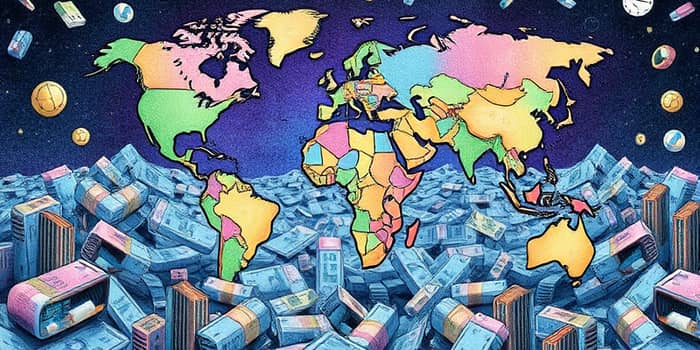
Debt has become one of the defining forces of our era, shaping policies, influencing markets, and touching lives on every continent. As borrowing expands, understanding its dynamics is vital for global stability and personal empowerment.
Today, global debt now exceeds $346 trillion, equivalent to roughly 310 percent of global GDP. This unprecedented scale reflects post-pandemic recovery efforts, infrastructure programs, and evolving investment strategies across nations.
Global public debt alone surpassed $100 trillion in 2024 and is projected to approach 100 percent of global GDP by the decade’s end. In the United States, mounts of federal spending pushed the fiscal deficit to an average of 5.1 percent of GDP, with forecasts climbing to 6 percent by 2027—levels unseen since World War II.
Heightened geoeconomic uncertainty is adding fiscal pressure as governments respond to trade tensions, security challenges, and energy transitions. Coupled with multi-decade low interest rates reversing course, borrowing costs have surged, testing the limits of fiscal flexibility worldwide.
Debt does not reside in a single pocket but spans varied sectors, each carrying unique risks and opportunities.
Emerging markets recorded over $115 trillion in total debt by Q3 2025, driven by China, Brazil, and Russia, while mature economies added $17 trillion, led by the U.S., France, and Germany. Currency shifts—especially a softer U.S. dollar—have inflated dollar-denominated obligations for many non-U.S. borrowers, compounding refinancing risks.
The shift from near-zero to elevated interest rates has magnified the burden of interest payments. Today, debt servicing costs are higher and compete directly with critical investments in healthcare, education, and green infrastructure.
For mature markets, over $16 trillion in bonds and loans mature in 2026 alone. Governments and corporations must navigate refinancing amid tightening credit conditions. The U.S. federal reserve balance sheet, which swelled to $6.5 trillion, underscores the scale of monetary support deployed—and the challenges ahead.
In many low-income countries, high borrowing costs and limited access to affordable finance have strained budgets. Heavy debt service obligations risk diverting resources from poverty alleviation and climate adaptation efforts.
A looming shortfall in foreign aid further constrains policy choices. Without concerted global cooperation and innovative financing mechanisms, vulnerable nations may face debt distress and social setbacks.
Amid towering national figures, households can still exert control over their own financial destinies. Effective strategies turn borrowing from a source of anxiety into a tool for growth.
Beyond repayment tactics, building an emergency fund and seeking professional credit counseling can help individuals break free from the debt cycle and foster lasting financial resilience.
As our world confronts climate change and social inequities, the sustainable debt universe offers a path toward responsible borrowing. By October 2025, the market for green, social, and sustainability-linked bonds reached $7.8 trillion.
These instruments align capital with environmental projects, affordable housing, and health initiatives, creating measurable impact and transparent accountability. Though issuance slowed in 2025, continued innovation and robust frameworks can revitalize growth in this critical segment.
Whether at the level of nations or individual families, acknowledging the realities of debt is the first step toward mastering its challenges. With clear strategies and collaborative policy solutions, we can transform debt from a burden into a lever for sustainable progress.
By combining responsible public borrowing, innovative sustainable finance, and empowered personal decision-making, we chart a course toward resilient economies and brighter futures for all.
References